
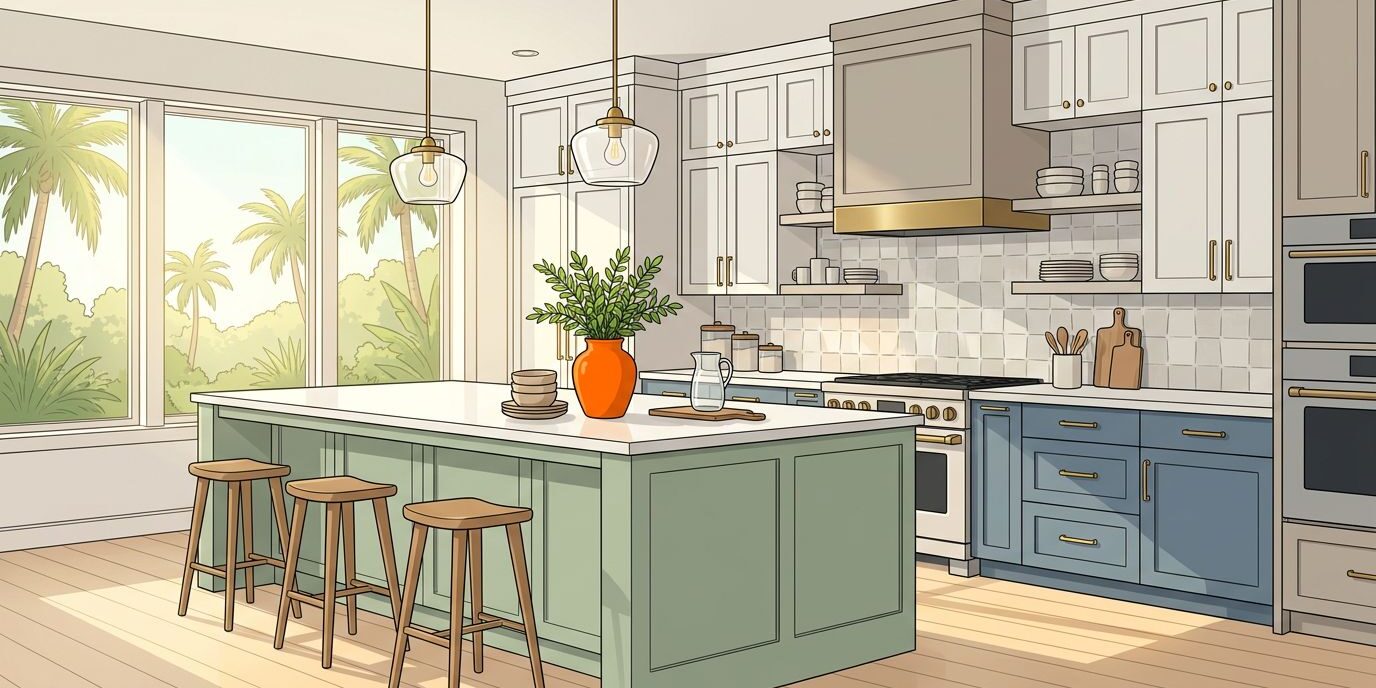
Bright Florida sunlight is beautiful, but it can expose the wrong undertone, especially on white cabinets. The best kitchen cabinet colors for bright Florida homes need to work with your backsplash, countertops, walls, and the strong light that fills the room.
When homeowners ask us about kitchen cabinets, we start with the fixed finishes already in the kitchen. Then we consider how options such as a warm white will hold up to cooking, cleaning, humidity, and everyday use. The right paint colors should coordinate with those finishes, feel fresh today, and stay attractive for years.
Key Takeaways
- The best kitchen cabinet colors for bright Florida homes coordinate with the backsplash, countertops, flooring, walls, and the room’s natural light.
- White, off white, warm greige, light taupe, muted blue, and soft sage are dependable choices for Florida kitchens.
- Always test paint samples beside the fixed finishes and observe them in morning, afternoon, and evening light before choosing a cabinet color.
- Use contrast thoughtfully by keeping perimeter cabinets light and adding deeper shades, such as navy or charcoal, to the island when appropriate.
- A durable satin or semi gloss finish, thorough preparation, and proper curing are essential for cabinets that can handle daily kitchen use.
Florida kitchen cabinet color ideas
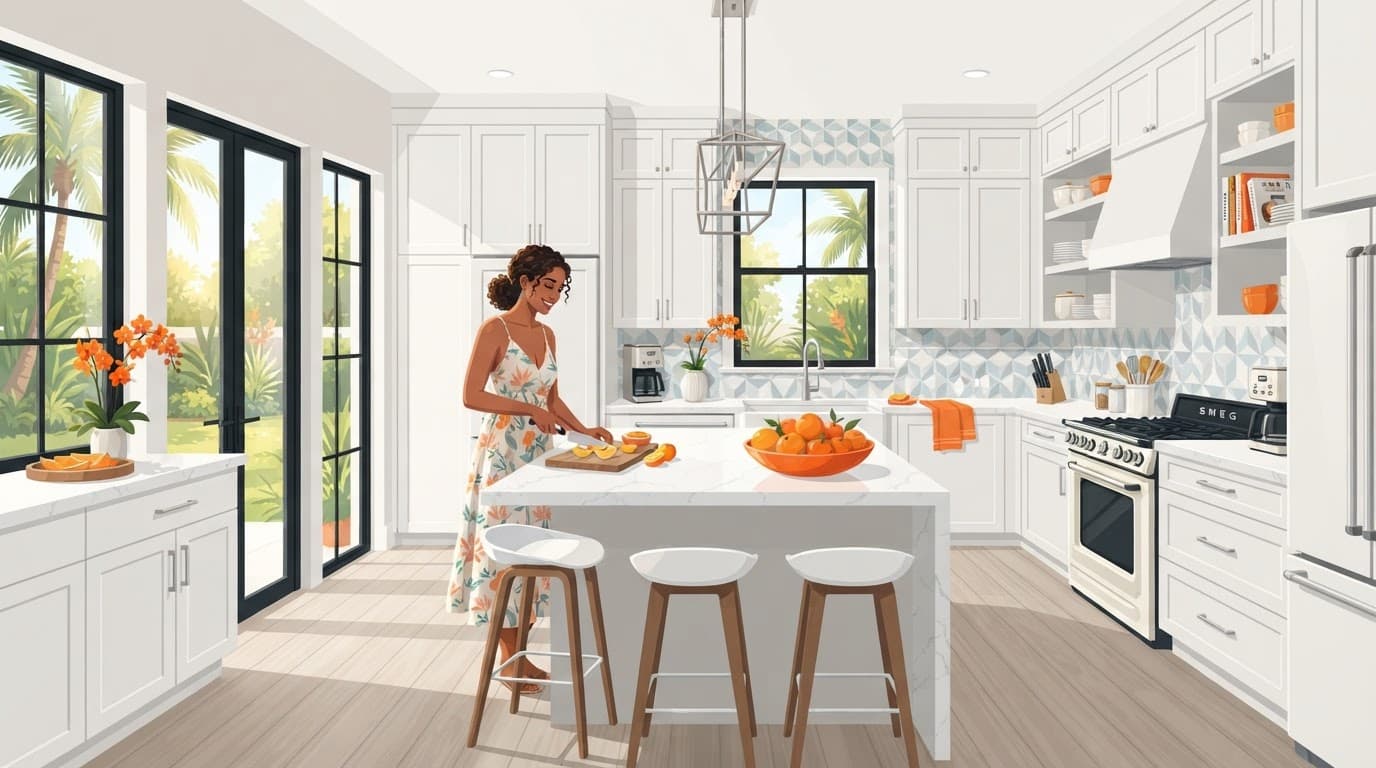
White cabinets remain one of the safest choices for a bright Florida kitchen. They reflect natural light, make smaller spaces feel more open, and work with nearly every countertop material. However, the best paint colors depend on existing kitchen cabinets, the kitchen backsplash, and the room’s other finishes.
White and off white cabinet colors
Crisp white cabinets, such as Benjamin Moore Chantilly Lace, look clean and modern. They work well with cool gray quartz countertops, stainless steel appliances, and simple backsplashes. In a kitchen with warm flooring or cream-colored stone, a softer white is usually more comfortable.
Popular warm and balanced options include:
- Benjamin Moore Cloud White
- Benjamin Moore White Dove
- Benjamin Moore White Heron
- Benjamin Moore Pale Oak
- Sherwin Williams Alabaster
- Sherwin Williams Pure White
- Sherwin Williams Shoji White
Bright white can look blue in strong daylight if the surrounding finishes are cool. Warm white can look yellow beside a stark white countertop. Compare these white paint colors with the room’s fixed finishes before committing. Always test paint samples on the actual cabinet surface during the morning, afternoon, and evening.
Greige and light neutral paint colors
Warm greige is a dependable choice when you want more color without making the kitchen feel dark. It offers a softer alternative to gray paint colors. It also coordinates with wood cabinets, wood floors, stone counters, brushed metal hardware, and natural stone.
Light taupe, mushroom, and soft beige also work well in Southwest Florida homes. These neutral paint colors feel comfortable and forgiving. For more inspiration, review these white paint colors for cabinets before comparing options in your own space.
Soft blue and green
Blue paint colors work best in muted shades. Pale blue, sea glass, and dusty blue bring color into the kitchen without becoming overwhelming.
Green paint colors, including muted sage and soft coastal green, pair well with white walls, light quartz, and natural wood accents.
Use stronger colors carefully. A dusty blue usually has more staying power than a bright turquoise. A muted green is easier to live with than a highly saturated shade that dominates the room.
Once you narrow the palette, choose a cabinet paint product that suits daily use.
Let the kitchen backsplash and countertop lead the color choice
The backsplash is one of the first things we review before selecting a color for existing kitchen cabinets. It sits directly beside and above the cabinets, so its undertone strongly affects the finished room. If there isn’t a backsplash, use the countertop as your main reference.
A warm backsplash with cream, tan, or beige movement usually looks better beside warm white, greige, or light taupe cabinets. A backsplash with blue-gray, green-gray, or bright white tones can support cooler whites and soft gray cabinets. Quartz countertops and wood cabinets can also add undertones that affect how a cabinet shade appears.
A cabinet color can look perfect on a paint card and wrong beside a countertop. Test the sample next to the fixed finishes, not by itself.
Use this quick undertone check:
- Hold a cabinet sample against the backsplash in natural light.
- Place paint samples beside the backsplash and countertop.
- Compare the samples beside the flooring and wall color.
- Look for unwanted yellow, pink, blue, or green tones.
- Check the sample beside cabinet hardware and appliances.
- Leave the sample in place for at least one full day.
If the backsplash has several colors, choose a cabinet shade that matches its quietest background tone. Busy tile usually needs neutral paint colors, such as warm greige, taupe, or beige, to create balance. A simple backsplash gives you more freedom to use navy, sage, charcoal, or another stronger color.
A well-planned backsplash can also add texture and personality without fighting the cabinet color. Our color consulting process helps homeowners coordinate these details through professional kitchen remodeling services, including cabinet, countertop, tile, and lighting decisions.
Use contrast wisely on the island and walls
Your kitchen island doesn’t need to match the perimeter cabinets. Kitchen cabinets around the kitchen island can coordinate through hardware, lighting, or the backsplash, creating depth and a custom look.
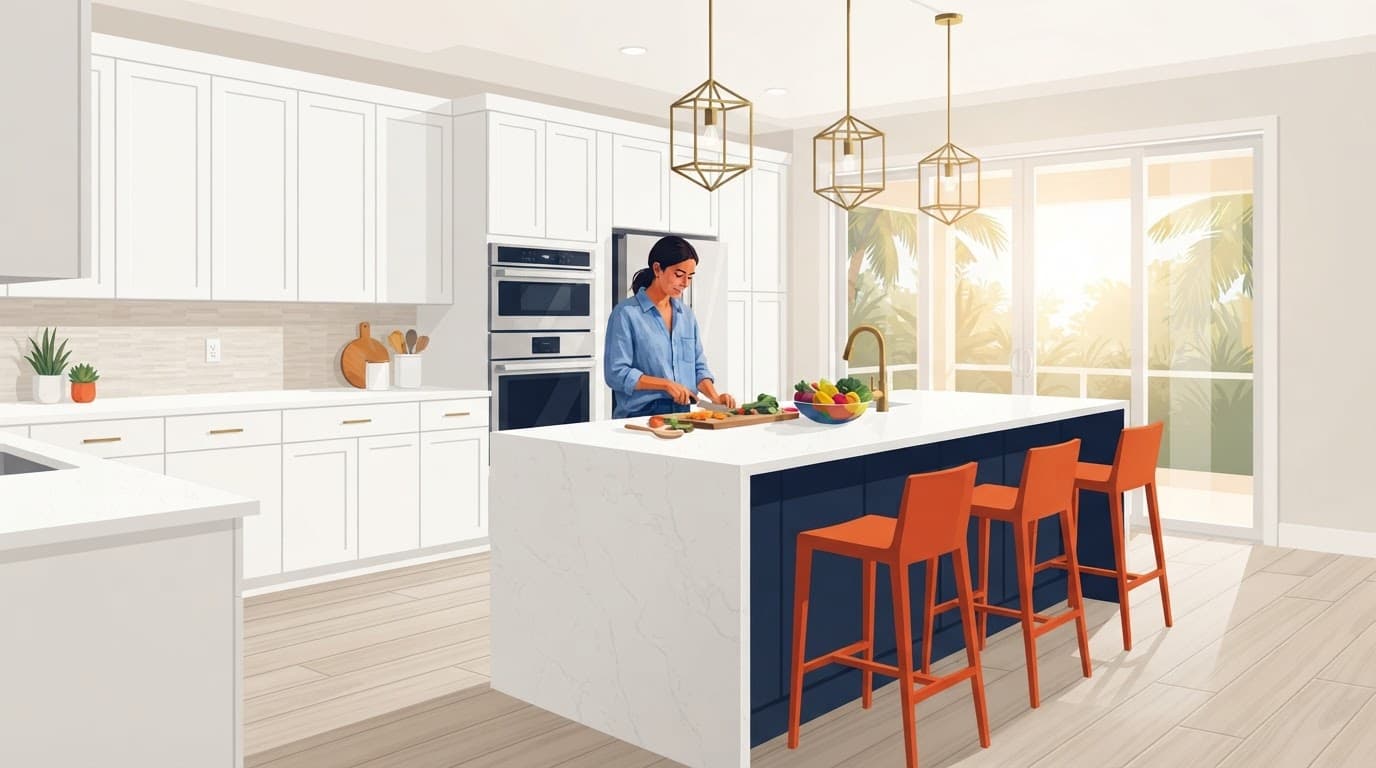
These combinations are dependable starting points, especially when white cabinets keep the perimeter bright:
| Perimeter cabinets | Island color | Overall effect |
|---|---|---|
| Warm white | Navy blue | Bright with strong contrast |
| Soft greige | Wood cabinets | Warm and relaxed |
| Light blue | White | Coastal and airy |
| White | Charcoal gray | Modern and grounded |
| Pale sage | Deep green | Natural and distinctive |
Navy is one of our favorite island colors because it feels rich without the heaviness of black. Wood cabinets offer a warm island or perimeter option, while charcoal works well in larger kitchens with plenty of windows. If the kitchen is small, keep the perimeter cabinets light and limit dark cabinets to the island.
Your wall color doesn’t have to be dramatically lighter or darker than the cabinets. A wall and cabinet color from the same family can look polished when the values or finishes are different. For example, warm white cabinets can work with a slightly deeper beige wall. White cabinets can also pair with gray paint colors for a clean separation.
Use paint samples on both the cabinets and walls, and avoid a high gloss surface that reflects intense Florida sunlight. A color that looks neutral in a shaded showroom may appear much warmer under Florida sunshine.
Choose a paint finish that fits daily use
Cabinets need a finish that can handle fingerprints, cooking grease, moisture, and repeated wiping. For kitchen cabinets, both a satin finish and semi gloss suit most kitchens. High gloss can create a striking look, but it requires careful preparation.
A satin finish has less reflection and hides minor surface flaws better. It gives cabinets a smooth, soft appearance without making them look flat. Semi gloss reflects more light and is easier to wipe clean, but it shows uneven sanding, dents, and brush marks.
High gloss can work in a modern kitchen, especially with clean lines and minimal visual clutter. Wood cabinets often show grain and surface variation, so a softer sheen can minimize distractions. In bright Florida sunlight, high gloss reflects strongly and can make glare more noticeable.
Two popular cabinet paint options are Benjamin Moore Advance Interior and a Sherwin Williams urethane enamel.
| Paint | Formula and feel | Best fit |
|---|---|---|
| Benjamin Moore Advance Interior | Waterborne alkyd with strong leveling | Smooth, furniture-style cabinet finish |
| Sherwin Williams Emerald Urethane | Water-based urethane enamel with a durable finish | Frequently used for cabinets, doors, and trim |
Benjamin Moore Advance Interior is known for strong leveling, which can help create a smooth finish when applied correctly. That smooth result suits furniture-style cabinets, but high gloss can reveal every sanding flaw. It usually requires patience between coats and during curing.
Sherwin Williams Emerald Urethane is designed for durable trim and cabinet applications. It resists yellowing and sticking when properly applied, and Sherwin Williams’ application guidance emphasizes proper drying and curing. Compared with Benjamin Moore Advance Interior, it rewards careful application and adequate cure time.
Neither product fixes poor preparation, since surface condition, primer, application method, drying conditions, and cure time affect the result. Read Benjamin Moore’s current instructions before starting, and allow Advance Interior enough time to cure before heavy use. Review Sherwin Williams’ official kitchen paint color guide when comparing products and paint colors. A final high gloss coat will make any remaining flaw more obvious.
Follow the right prep steps before painting
Painting kitchen cabinets is possible as a DIY project, but preparation takes more time than most homeowners expect. Rushing this part leads to peeling, visible grease spots, rough edges, and doors that stick.
Follow these steps:
- Remove the doors, drawer fronts, hinges, and hardware. Label each piece so everything returns to its original location.
- Clean every surface with a cabinet-safe degreaser. White cabinets can reveal grease, sanding dust, and uneven edges, so focus on handles, the range, and sink.
- Repair dents, cracks, and damaged edges before sanding. Replace worn parts on wood cabinets instead of hiding serious damage with paint.
- Sand high gloss surfaces until they are dull and smooth. Remove dust completely with a vacuum and clean cloth.
- Choose a compatible primer and paint system for your coating, such as Benjamin Moore Advance Interior or Sherwin Williams Emerald Urethane. Wood cabinets, stained surfaces, and previously painted finishes may need different primer choices.
- Apply two thin coats of cabinet paint. Follow the manufacturer’s current recoat and drying instructions for Advance Interior between coats. For Sherwin Williams products, follow the product-specific application and curing instructions.
Paint the doors flat when possible, and keep the work area clean. If using Advance Interior, cure it according to current manufacturer instructions before reinstalling the doors, and avoid closing them until the finish hardens. A professional can also help when the cabinets have water damage, poor construction, or a layout that no longer works.
Compare painting, refacing, and replacement costs
Before choosing a project type, evaluate your existing kitchen cabinets, their condition, layout, and storage needs. White cabinets or wood cabinets may only need refinishing when the boxes remain sound. Refacing or repainting dark cabinets can create a cabinet makeover, but damaged boxes may favor new cabinetry.
In a full kitchen remodel, cabinets often account for about 35% to 40% of the project budget. Countertops and backsplash work may add another 15% to 20%, while design, demolition, delivery, permits, installation, and cleanup can affect the final quote.
Our cabinet refacing and replacement options explain the difference between updating existing cabinet surfaces and installing a new system. A detailed quote should separate cabinet work, cabinet paint, hardware, countertops, and labor so you can compare projects accurately.
Frequently Asked Questions
What are the best cabinet colors for a bright Florida kitchen?
White, off white, warm greige, light taupe, muted blue, and soft sage are all strong options. The best choice depends on the undertones in the backsplash, countertops, flooring, walls, and other fixed finishes.
Should I choose warm white or bright white cabinets?
Bright white cabinets can work well with cool gray quartz, stainless steel appliances, and simple backsplashes. Warm white is usually more comfortable beside cream-colored stone, warm flooring, or beige finishes, but samples should be tested in the actual room.
What cabinet color works best with a busy backsplash?
A busy backsplash usually looks more balanced with neutral cabinet colors, such as warm greige, taupe, beige, or a softer white. Choose a shade that relates to the backsplash’s quietest background tone rather than its most noticeable color.
Can the kitchen island be a different color from the cabinets?
Yes, a contrasting island can add depth and create a more custom look. Navy, wood, charcoal, deep green, and other darker shades can work well when the perimeter cabinets remain light and the island coordinates with the hardware, lighting, or backsplash.
What paint finish is best for kitchen cabinets?
Satin and semi gloss finishes suit most kitchen cabinets because they balance durability, cleanability, and appearance. Satin hides minor surface flaws better, while semi gloss is easier to wipe clean but can highlight dents, uneven sanding, and brush marks.
Conclusion
The best kitchen cabinet colors for a Florida home are paint colors that respond to strong natural light and existing finishes. White cabinets, off white doors, and warm white remain dependable choices, while deeper shades add contrast when used carefully.
Compare white paint colors in the actual room, then test each option in daylight. Choose a durable paint finish for kitchen cabinets, such as a satin finish or semi gloss.
With thoughtful preparation and balance, the result is a brighter, more comfortable kitchen and a lasting cabinet makeover.